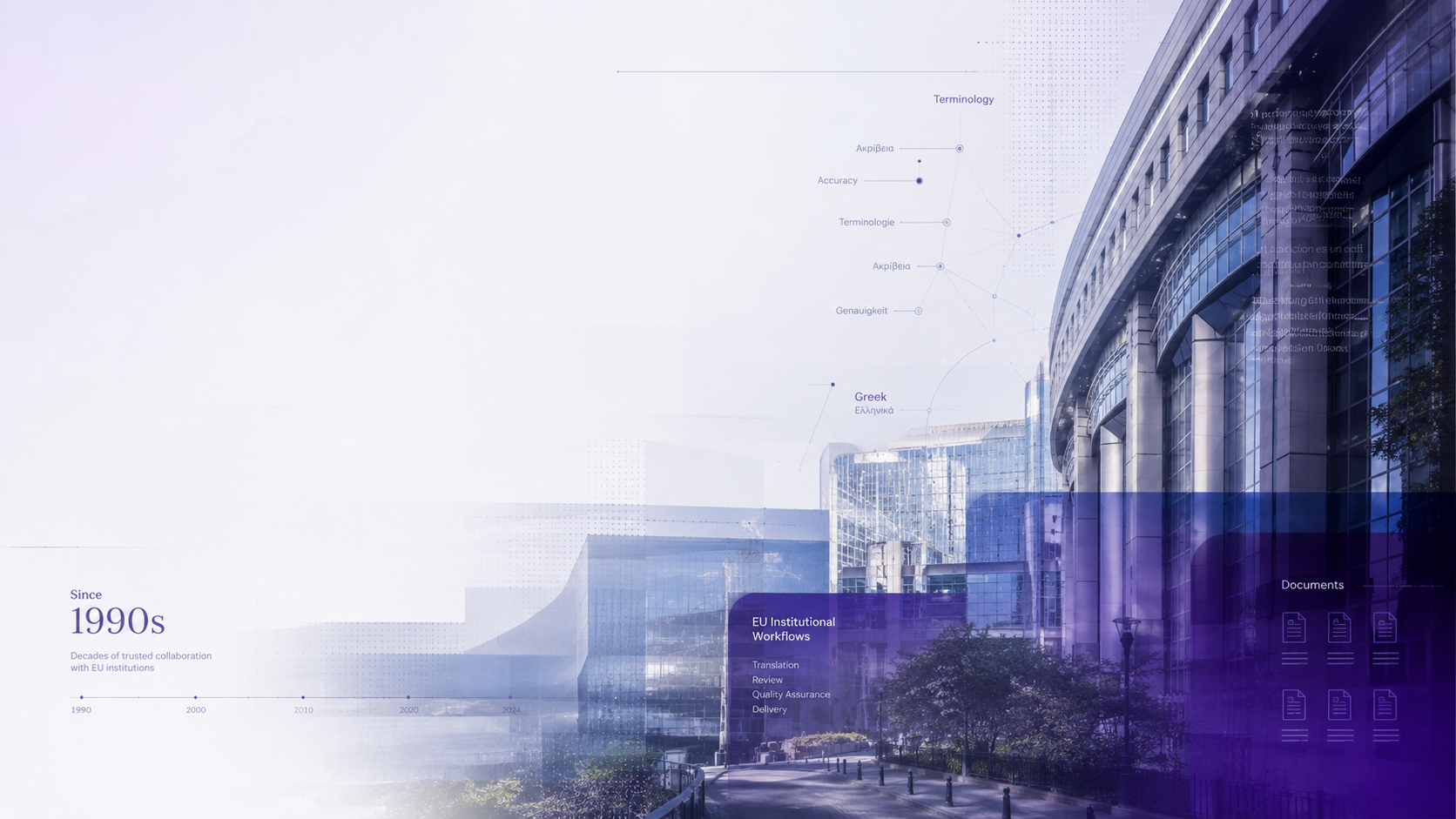
From EURODICAUTOM to EU Institutional Workflows: Omada’s Long-Term Role in Greek Translation and Terminology
How Omada’s legacy in Greek terminology, EU translation and institutional language services has supported complex European content from the 1990s to recent years.
For organisations working in legal, regulatory, technical and institutional environments, translation is never just a language task. It is also a matter of accuracy, consistency, confidentiality and trust.
Since 1991, Omada has built its work around this demanding reality. The company provides Greek translation services and multilingual language services for content where terminology, context and quality assurance are essential.
One important part of this story is Omada’s long-standing work connected with Translation Centre for the Bodies of the European Union institutional translation workflows. This includes EU-related translation needs from the 1990s through to recent years.
From early terminology work linked to EURODICAUTOM, now known as IATE, to later EU institutional translation projects, Omada’s experience reflects continuity, discipline and a strong understanding of European public-sector content.
A Legacy Rooted in EU Terminology
Omada’s connection with EU language work goes back to the 1990s. At that time, the company was involved in translating into Greek some of the first terms for what was then known as EURODICAUTOM.
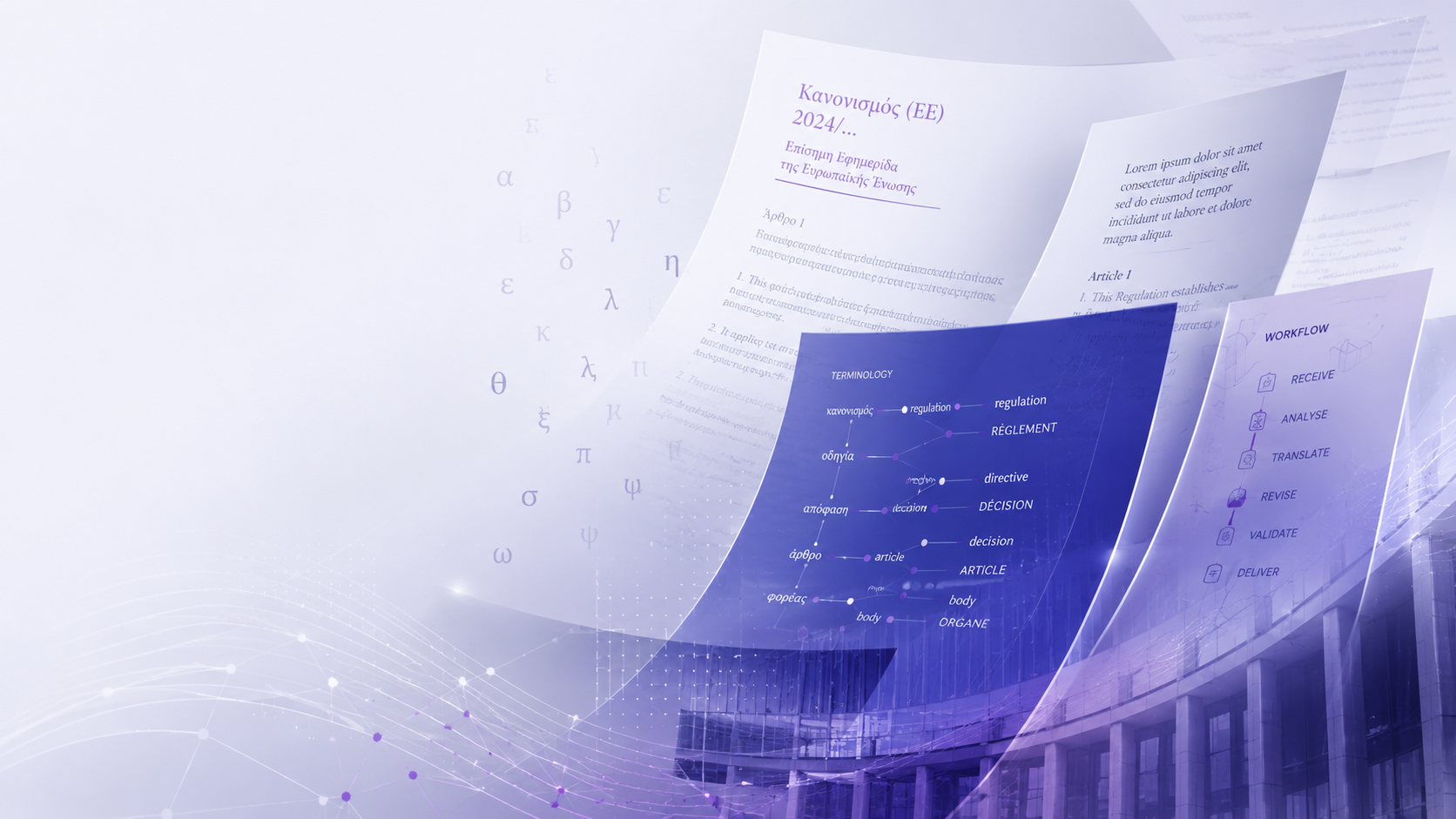
EURODICAUTOM later evolved into IATE, the European Union’s interinstitutional terminology database. For Omada, this early work was not only a translation assignment. It was also a formative experience in terminology management and institutional language.
The work required precision, conceptual clarity and careful Greek equivalents. In addition, it required an understanding of how specialised terminology would be used in legal, technical and administrative contexts over time.
That foundation continues to shape Omada’s approach today. Whether the subject is technical regulations, public health, finance, aviation, cybersecurity, justice, intellectual property or environmental policy, the same principle applies: terminology is infrastructure.
The Challenge: Translating High-Stakes Institutional Content
EU translation and institutional translation workflows have their own demands. They involve multiple stakeholders, strict style expectations, complex terminology and evolving regulatory frameworks.
In addition, this type of content often carries public accountability. A term may have legal force. A phrase may need to remain consistent across years of institutional documentation. Even a small ambiguity can create unnecessary risk.
This is especially true in European Commission translation, EU agency content and public-sector language workflows. These texts often sit at the intersection of policy, law, science, technology and administration.
Typical requirements in EU-related workflows
Omada’s work connected with CdT and EU institutional content has required the ability to handle:
- terminology-sensitive Greek translation services;
- legal and regulatory translation for public-sector use;
- technical regulations and specialised technical content;
- multilingual language services across structured institutional workflows;
- translation quality assurance under demanding delivery conditions;
- confidential content requiring discretion and controlled handling;
- consistency across repeated, related or long-running documentation streams.
For this reason, generic translation processes are not enough. These environments require linguistic expertise, institutional memory and mature quality-control practices.
The Solution: Institutional Memory, Terminology Discipline and Structured QA
Omada’s work in EU-related language workflows combines senior linguistic judgement, terminology discipline and structured translation quality assurance.
Rather than treating each project as an isolated text, Omada approaches institutional translation as part of a broader knowledge system. Previous terminology, domain conventions, client preferences, style expectations and relevant EU usage all inform the final Greek text.
As a result, the translation process becomes more consistent and reliable. This matters especially when content is updated, repeated or used across several related workflows.
Terminology as a strategic asset
For EU and public-sector content, terminology management is central to quality. Omada’s early work connected with EURODICAUTOM helped shape a methodical approach to specialised terminology.
In practice, this means identifying concepts accurately, applying established Greek equivalents where appropriate and maintaining consistency across related texts. It also means knowing when a term requires contextual judgement rather than mechanical repetition.
This is particularly important in fields such as public health, financial supervision, justice, safety, intellectual property, aviation, cybersecurity, environmental regulation and technical standardisation.
Quality assurance for regulated and institutional content
Omada’s translation quality assurance practices are designed for content where reliability is essential.
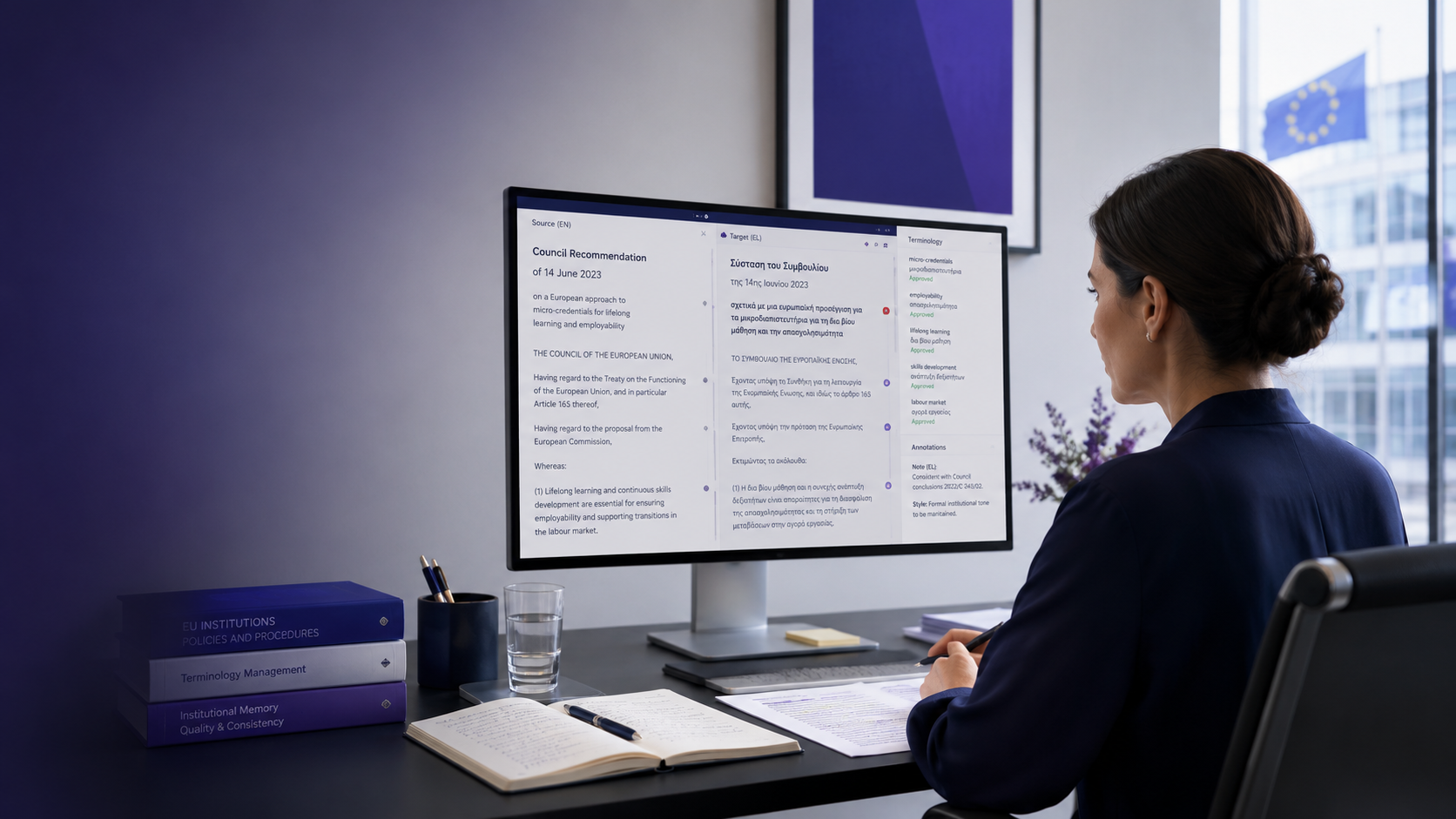
Depending on the workflow, this may include terminology checks, bilingual review, consistency control, formatting review, style alignment and verification of names, references and institutional wording.
The aim is not only to produce fluent Greek. The aim is to produce Greek that is accurate, traceable, institutionally appropriate and fit for professional use.
Supporting CdT-Connected and EU Institutional Translation Workflows
Over the years, Omada has participated in multiple contracts and translation workflows connected with the Translation Centre for the Bodies of the European Union and wider EU institutional content.
Where appropriate, this work has been delivered through frameworks, subcontracting arrangements, language-service providers and EU-related institutional workflows. This distinction is important, because EU language work often involves layered procurement and delivery structures.
Through projects implemented for or connected with CdT workflows, Omada has provided language services across a wide range of languages, subject fields and European organisations.
These have included content connected with bodies and agencies such as EPPO, Europol, EMA, EFSA, the European Central Bank, the European Court of Auditors, the European Agency for Safety and Health at Work, the European Banking Authority, Frontex, ECDC, ECHA, Eurofound and EUAA.
In addition, Omada’s EU-related experience has included workflows connected with Eurojust, EASA, EUSPA, ENISA, SRB, JRC, the European Ombudsman, EUIPO, eu-LISA, ELA, EIOPA and EIGE.
This breadth matters. EU institutional content is rarely one-dimensional. A single workflow may involve legal terminology, regulatory references, scientific concepts, administrative conventions and highly specific institutional language.
Over time, this experience has strengthened Omada’s ability to support both Greek and multilingual language services with consistency and care.
The Impact: Reliable Greek Language Support for Complex European Content
Omada’s long-term contribution to EU-related translation and terminology workflows has created a valuable base of institutional knowledge.
The company understands the realities of public-sector language work. These include the importance of consistency, the need for discretion, the pressure of deadlines and the expectation that terminology must be handled with discipline.
For EU institutions, EU contractors, LSPs, public bodies and organisations working in legal, regulatory or technical fields, this experience creates practical value.
What clients gain from this experience
- Continuity: language support informed by decades of exposure to EU and institutional content.
- Terminology control: careful treatment of specialised terms, concepts and recurring institutional language.
- Greek expertise: senior-level Greek translation services for complex and sensitive material.
- Workflow maturity: experience working within structured, multi-stakeholder translation environments.
- Confidentiality: professional handling of public-sector, legal, regulatory and technical content.
- Quality assurance: review processes designed to support accuracy, consistency and fitness for use.
As a result, Omada can act as a Greek language partner for content that cannot afford to be vague, inconsistent or loosely translated.
Why This Matters Now
The language needs of European institutions and public-sector organisations continue to evolve. Artificial intelligence, machine translation, terminology databases and translation memories have changed the production environment.
However, these tools have not removed the need for expert human judgement. In many cases, they have made that judgement even more important.
This is especially true for EU translation, European Commission translation workflows, institutional translation and legal and regulatory translation.
The more technology enters the workflow, the more important it becomes to have experienced linguists who can validate terminology, detect conceptual inconsistencies and understand institutional context.
Omada combines long-standing translation experience with modern language technology, terminology management and human quality assurance. Therefore, the company can support organisations that need productivity without sacrificing precision.
A Trusted Greek Language Partner for EU and Institutional Content
Omada does not position itself through inflated claims. Its value lies in continuity, specialist experience and the ability to work with content that requires care.
Since 1991, the company has supported complex language needs across technical, legal, regulatory and institutional domains. It has also developed a particular strength in Greek and EU-related workflows.
From early terminology work connected with EURODICAUTOM to recent CdT-related and EU institutional translation workflows, Omada’s story is one of accumulated expertise.
It is a story of terminology discipline, institutional memory and professional reliability in areas where language has real consequences.
Discuss Greek and Multilingual Language Support with Omada
If your organisation requires Greek translation services, EU translation, institutional translation, terminology management or multilingual language services for legal, regulatory, technical or public-sector content, Omada can support you with a careful, structured and quality-driven approach.
We work with EU contractors, LSPs, public bodies, legal and regulatory organisations, technical teams and procurement managers that need language support they can trust.
Contact Omada to discuss Greek and multilingual language support for EU, institutional, legal, regulatory and technical content.