Localising Payment Confidence for the Greek Market
Greek fintech localization is not just a matter of translating payment terminology from English into Greek. For digital payments platforms, language directly affects user trust, product clarity and the overall customer experience. When Greek-speaking businesses interact with payment workflows, onboarding content or website messaging, the wording must feel clear, consistent and commercially reliable.
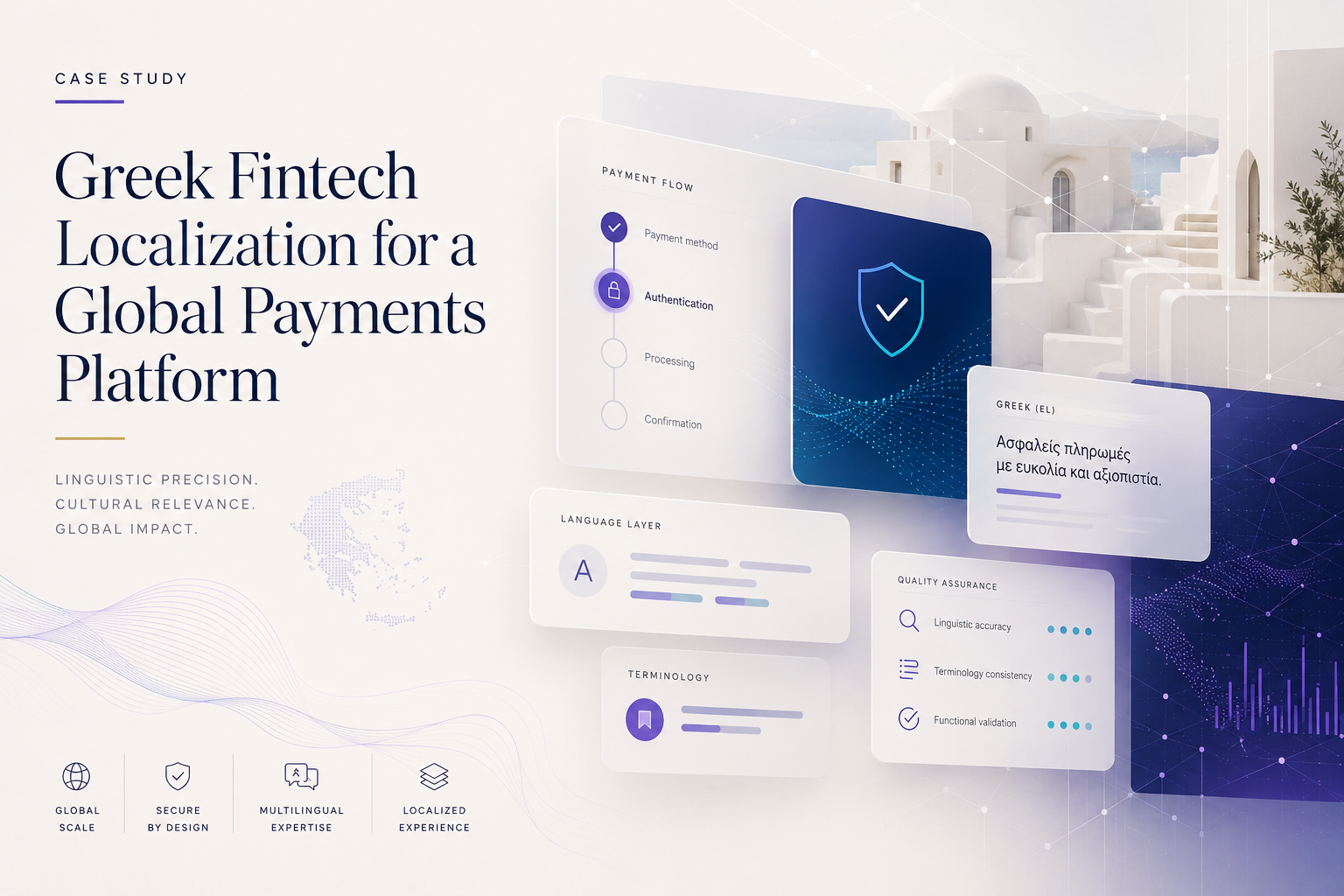
Delivered through an international language services partner, Omada contributed to the Greek localization of public-facing content for a global payments platform. The project required terminology-sensitive fintech translation, Greek UX localization, website content adaptation and linguistic quality assurance, with the goal of supporting Greek-speaking users through precise, natural and trustworthy content.
Project Overview
A leading international fintech platform needed Greek-language content that could support local users without weakening the clarity, tone or usability of the original digital experience. The content was connected with a global payments environment, where wording has to be accurate, concise and immediately understandable.
Omada’s role focused on English-to-Greek localization of public-facing platform and website content. The work required careful handling of payments terminology, recurring product concepts, user-facing instructions, microcopy and commercially sensitive digital content.
The objective was not simply to “translate the website”. The objective was to help create a Greek-language experience that felt natural, reliable and aligned with the expectations of business users interacting with modern payment technology.
The Challenge
Fintech content is unforgiving. A phrase that sounds acceptable in a general translation can become problematic inside a payment workflow, a product page or a user action sequence. In digital payments, users need to understand what is happening, what they are being asked to do and what the outcome of each action will be.
This creates a localization challenge that goes beyond linguistic accuracy. The Greek content had to remain clear, concise and usable while preserving the tone of a global technology brand. It also had to avoid the two most common problems in fintech translation: awkward literal wording and unnecessarily heavy technical language.
Key project requirements
- English-to-Greek translation and localization of digital payments content
- Clear handling of fintech and payments terminology
- Adaptation of website and platform-facing content
- UX-sensitive wording for Greek-speaking users
- Consistency across recurring product and payment concepts
- Linguistic quality assurance and revision
- Preservation of a polished international technology tone
- Avoidance of literal, unnatural or overly technical Greek phrasing
Why Fintech Localization Is Different
Fintech localization requires more than subject-matter knowledge. It also requires an understanding of how language functions inside a digital product. Users do not experience payment content as isolated text. They encounter it while comparing services, creating accounts, reviewing information, completing actions or trying to understand a payment-related process.
For this reason, Greek fintech localization must support both accuracy and user confidence. Terms connected with payments, verification, transactions, accounts, security, business operations and platform functionality need to be rendered in Greek in a way that feels precise but not obscure, professional but not bureaucratic, and concise but not vague.
In this type of content, every wording decision matters. The wrong phrase can create uncertainty. Inconsistent terminology can make a platform feel less reliable. Overly literal translation can make a global product feel foreign rather than localized.
Why Greek Fintech Localization Requires Specialist Judgment
Greek fintech localization requires a careful balance between technical accuracy and natural user-facing language. Payment-related content often includes concepts that are familiar to international technology teams but less straightforward when rendered directly into Greek. A literal translation may be technically understandable, but still sound heavy, unnatural or disconnected from the way Greek business users expect digital services to communicate.
For this reason, Omada’s work focused on producing Greek content that could support real digital journeys. The language had to remain concise enough for website and platform use, precise enough for payment-related concepts and polished enough to reflect the credibility of an international technology brand.
This is where fintech translation becomes more than word replacement. It becomes a structured localization process involving terminology control, UX awareness and linguistic quality assurance.
The result is Greek-language content that helps users understand payment concepts, move through digital interfaces with greater confidence and experience the platform as genuinely accessible in their own language.
The Greek Market Context
Greek-speaking users expect digital platforms to feel coherent, practical and credible in Greek. This is especially important in financial technology, where trust is central to the user experience. If the language sounds unnatural, inconsistent or obviously translated, it can create friction even when the underlying product is strong.
For business users in particular, payment-related content must communicate reliability. The Greek wording needs to be clear enough for fast comprehension, formal enough to support trust and flexible enough to work across website pages, product descriptions and interface-related content.
Greek UX and website localization therefore requires more than linguistic correctness. It requires sensitivity to register, digital readability, terminology discipline and user expectations. A successful Greek version should not feel like an afterthought. It should feel like a platform prepared to serve the Greek market properly.
Omada’s Role
Delivered through an international language services partner, Omada supported the Greek localization workflow for a global payments platform by focusing on linguistic quality, terminology consistency and user-facing clarity.
The work included translation and localization of public-facing platform content, careful handling of recurring fintech terminology, review of Greek phrasing and refinement of wording where literal translation would have weakened the user experience.
Omada approached the assignment as structured digital content adaptation. That means looking not only at individual sentences, but also at how terms, messages and content patterns work together across the broader user journey.
Omada’s contribution included:
- English-to-Greek localization of website and platform content
- Terminology-sensitive handling of payment-related concepts
- Adaptation of UX-sensitive content into natural Greek
- Consistency checks across repeated terms and content structures
- Revision for fluency, tone and clarity
- Linguistic quality assurance for Greek-speaking users
Terminology and UX Considerations
One of the most important parts of the project was terminology control. Fintech platforms rely on repeated concepts. If these concepts are translated inconsistently, the user experience becomes weaker. The content may still be understandable, but the platform begins to feel less coherent.
In Greek, this is particularly important because English fintech terms often enter the market quickly, sometimes before stable Greek usage has fully formed. The translator must decide when to use established Greek terminology, when to preserve a more international digital tone and when to adapt the phrase to make the concept clearer for the user.
Core terminology priorities
- Keeping recurring payment concepts consistent across the Greek content
- Avoiding awkward calques from English
- Using Greek wording that supports trust and comprehension
- Maintaining a modern digital tone
- Balancing technical precision with user-friendly readability
UX-sensitive translation was equally important. Interface-related content often has limited space and must guide the user quickly. The Greek version had to remain concise, but also natural. It had to support user action without sounding mechanical, vague or over-translated.
Quality Assurance Workflow
For fintech and digital platform content, quality assurance is not a final cosmetic check. It is part of the value of the localization process. A payments platform needs content that users can trust, and trust depends partly on linguistic consistency and clarity.
Omada’s quality-focused approach included reviewing the Greek content for terminology alignment, naturalness, tone, readability and contextual suitability. Particular attention was given to whether the wording worked as part of a digital journey, not just as a correct standalone translation.
QA focus areas
- Terminology consistency across repeated concepts
- Clarity of payment-related wording
- Natural Greek syntax and phrasing
- Alignment with the tone of a global technology platform
- Reduction of literal or awkward translation patterns
- UX suitability for website and platform content
This quality assurance process helped ensure that the Greek content could support user understanding, product credibility and a smoother digital experience.
Outcome and Value Delivered
The project helped support Greek-speaking users with clearer, more consistent and more commercially reliable content for a global payments platform. Through terminology-sensitive localization and careful linguistic review, Omada contributed to a Greek-language experience better suited to the expectations of local business users.
The value was not only linguistic. It was also practical. Strong localization helps users understand product information, follow digital workflows and trust the content they are reading. In payments, this is especially important because language can either reduce friction or create hesitation.
By contributing to the Greek localization of this platform content, Omada supported the broader goal of making international payment technology more accessible, understandable and credible for the Greek market.
What This Project Demonstrates
This case study demonstrates Omada’s ability to support complex localization workflows for high-value digital content. It also reflects the company’s broader experience in terminology-sensitive language services, where accuracy, consistency and quality control are essential.
The project highlights Omada’s strengths in:
- Greek fintech localization
- Greek website localization
- SaaS and digital platform content
- UX-sensitive translation
- Terminology management
- English-to-Greek linguistic quality assurance
- Localization for complex and regulated business environments
For technology companies, fintech platforms and SaaS providers, localization is not a secondary step after product development. It is part of how the product is understood in each market.
Digital Finance, Trust and Local Language
As digital finance continues to develop across Europe, users increasingly expect online financial and payment services to be clear, secure and accessible in their own language. The European Commission’s work on digital finance also reflects the growing importance of trustworthy digital financial services across the European market.
For companies expanding internationally, this creates a clear localization requirement. Payment content must be accurate, but it must also be usable. Greek-speaking users need content that explains, guides and reassures without sounding like a literal transfer from English.
Related Greek Localization Services
This project reflects Omada’s broader expertise in translation and localization, terminology management and MTPE and AI-output review for complex digital, financial and technology content.
Omada supports organizations that need professional Greek language services for terminology-sensitive content, including fintech, SaaS, legal, financial, medical, institutional and technology-related material.
Conclusion
When digital payment platforms enter or serve a local market, language becomes part of the user experience. It shapes clarity, confidence and trust. In Greek, this requires more than accurate translation. It requires controlled terminology, natural wording, UX awareness and disciplined quality assurance.
Delivered through an international language services partner, this project reflects the kind of work Omada is built to support: complex, terminology-sensitive localization for organizations that need their content to perform clearly and professionally in Greek.
Need Greek Localization for a Fintech or SaaS Platform?
If your organization needs Greek fintech localization, SaaS localization, website translation or terminology-sensitive Greek content, Omada can support your project with clear, consistent and quality-focused language services.
From public-facing website content to platform workflows and specialized terminology, we help international businesses communicate with Greek-speaking users in a way that feels accurate, natural and market-ready.